Commuting from Southwest Las Vegas: Drive Times, Routes & Transportation Guide
How long does it actually take to get from Southwest Las Vegas to the Strip, the airport, Henderson, or Summerlin? Here are real drive times, the best routes, and everything a commuter needs to know.

Martin Guaglione
Realtor · eXp Realty · Licensed in Nevada (S.185010)
Martin Guaglione
Your Local Guide
I live in Southwest Las Vegas and I drive these roads every day. Whether I'm heading to a client meeting on the Strip, picking someone up from the airport, or grabbing dinner in Summerlin, I know exactly how long each trip takes and which route avoids the headache. If you're considering moving to the Southwest, your commute is probably one of your biggest questions. Here are the real numbers — from someone who actually makes these drives.
One thing I hear from buyers who move here from bigger cities is that everything in Las Vegas is close. It's true. Even the longest commute from the Southwest is under 40 minutes most days. But the right route and timing make the difference between a relaxing drive and sitting in traffic. Let's break it all down.
Drive Times from Southwest Las Vegas
Typical off-peak times from the 215/Durango area
Times vary by exact community and time of day. Add 10-15 min during peak rush hour.
These times are based on my real driving experience from the Durango Drive and 215 Beltway area, which is roughly the heart of the Southwest corridor. If you live in Southern Highlands, add a few minutes. If you're in Mountain's Edge, the Durango/Blue Diamond interchange puts you in roughly the same range. If you're in Rhodes Ranch, you're already right at the highway — your times might be on the lower end of each range.
The Major Routes: A Commuter's Guide
Five roads carry the vast majority of Southwest commuter traffic. Here's what each one does and when to use it.
I-215 Beltway (The Bruce Woodbury Beltway)
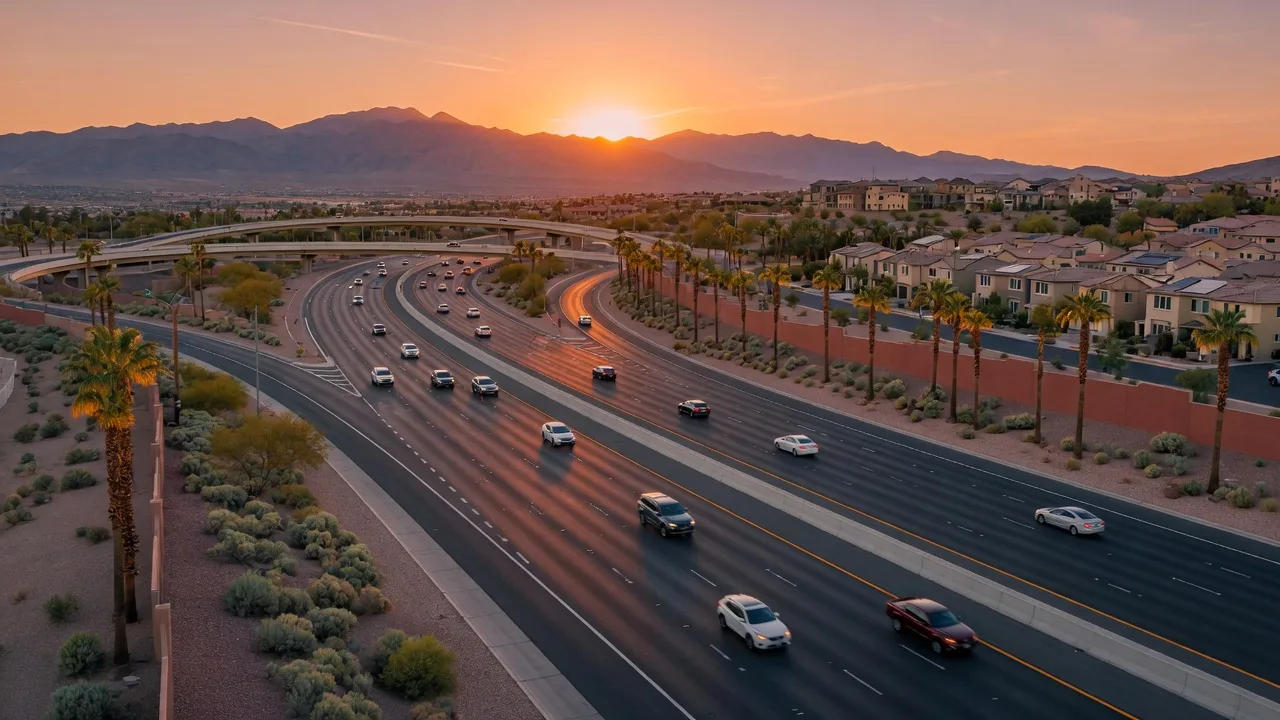
This is the backbone of Southwest commuting. The 215 runs east-west across the entire southern end of the valley, connecting the Southwest to Henderson, I-15, and the airport. From the Southwest, the 215 gives you direct access to I-15 (north to the Strip and downtown), Jones Boulevard, Durango Drive, Rainbow Boulevard, and the 215-Summerlin Parkway interchange.
The most significant recent improvement for Southwest commuters was the $84.6 million widening project between I-15 and Jones Boulevard, completed in early 2025. This added a lane in each direction and dramatically reduced the bottleneck that used to form during evening rush hour between the 15 and the Rainbow Curve. I drive this stretch almost daily, and the difference between 2024 and now is night and day. It's not completely congestion-free, but it flows measurably better than it did.
I-15
The north-south spine of the entire valley. From Southwest Las Vegas, you connect to the 15 via the 215 (heading east from the Beltway/15 interchange near Southern Highlands). The 15 takes you north to the Strip, downtown, and beyond. It's also the route to California and Utah.
The I-15 is where most rush-hour congestion happens for Southwest commuters. The stretch between the 215 and the 15/Strip exit (Flamingo Road / Tropicana Avenue) backs up predictably between 4:30 PM and 6:30 PM on weekdays. The recent NDOT widening of the I-15 south corridor and the Blue Diamond interchange improvements have helped, but this remains the bottleneck to watch.
Blue Diamond Road (NV-160)
Blue Diamond Road is the eastern edge of Southwest Las Vegas and a critical connector. It runs from I-15 west toward Mountain's Edge, Rhodes Ranch, and beyond to Red Rock Canyon. For Mountain's Edge residents, Blue Diamond is the main artery to the 215, the 15, and everything east. The Jones/Blue Diamond bridge improvements that neared completion in 2025 made a real difference for Mountain's Edge commuters, shortening what used to be a circuitous drive.
Jones Boulevard
Jones runs north-south through the western edge of the Southwest corridor, connecting Blue Diamond Road in Mountain's Edge to the 215, then continuing north toward Summerlin. It's the surface-street alternative when the 215 is congested. Jones is particularly useful for Mountain's Edge and Nevada Trails residents who need to reach the 215 without backtracking to Durango.
Durango Drive
Durango is the main north-south surface street through the heart of the Southwest corridor. It runs from Warm Springs Road south past the 215, through Rhodes Ranch, and continues past The Uncommons, The Bend, and the Durango Casino & Resort. Durango is the road you'll use most for local errands — restaurants, shopping, and entertainment are all clustered along it.
Durango during peak hours is congested. There's no sugarcoating it. The corridor between Sunset and the 215 sees heavy traffic between 7:30-9:00 AM and 4:30-6:30 PM. Signal timing improvements and turn-lane additions have helped, but the population growth keeps pace with the infrastructure improvements. The good news: because so many amenities are now built along Durango — The Uncommons, The Bend, Durango Casino, grocery stores, medical offices — you're driving less distance for daily errands than residents of most other valley neighborhoods.
The I-215 Widening: How It Changed the Commute
If you've lived in Las Vegas for more than a few years, you remember what the 215 between I-15 and Rainbow used to be like at 5:00 PM: a parking lot. The $84.6 million widening project, which added a travel lane in each direction on the four-mile stretch from I-15 to Jones Boulevard, has been the single most impactful infrastructure improvement for Southwest commuters in the last five years.
Here's what I notice as a daily driver: the evening backup that used to begin around the 15 interchange and stretch past the Jones exit has been cut by roughly half. Traffic still slows down, but it moves instead of stopping. The bottleneck has shifted east toward the 15 merge itself, which is really an I-15 capacity issue rather than a Beltway issue. For Southwest residents heading east toward Henderson, the widened 215 is a genuine improvement — and one of the reasons the corridor's growth has accelerated.
The next major project to watch is the $130 million Beltway-Summerlin Parkway interchange reconstruction, currently under active construction. When it's complete (likely 2027-2028), it will dramatically improve connectivity between the Southwest and the Summerlin corridor. For anyone who works in Summerlin and lives in the Southwest — and there are thousands of you — this will be one of the most impactful infrastructure projects in the valley.
Public Transit: What's Available and What's Not
Let me be upfront: Las Vegas is a driving city, and the Southwest corridor is no exception. Public transit is limited. The vast majority of Southwest residents drive. But the Regional Transportation Commission of Southern Nevada (RTC) does operate several bus routes through the area, and for certain trips they can be useful.
RTC Bus Routes Serving the Southwest
Route 102 (Durango/215): Runs along Durango Drive from the South Strip Transit Terminal (near the airport) through the Southwest corridor. Connects to the 215 Beltway Transit Center.
Route 104 (Blue Diamond): Serves Blue Diamond Road between the 215 and I-15, with connections to the Strip and downtown.
Route 206 (Eastern): While primarily serving the eastern part of the valley, it connects at the 215 Transit Center for Southwest residents transferring routes.
The RTC also operates paratransit services and the ACE (Alternative Commute Experience) express routes for commuters. For most Southwest residents, though, a car is the practical daily choice. The limited public transit is one reason I help many buyers factor parking and commute patterns into their home search — knowing where you need to go and when matters more in Las Vegas than in cities with comprehensive rail or bus systems.
Rush Hour Tips: How to Avoid the Worst Traffic
I've been commuting in this corridor long enough to have learned the patterns. Here are the tips I share with my buyers:
The 7:30 Window
If you can leave before 7:15 AM or after 8:30 AM, you'll miss the worst of the I-15 northbound congestion. The window between these hours is when the Strip-bound traffic stacks up from the 215 interchange past Tropicana. I aim for 7:00 AM departures to Strip meetings — smooth sailing.
Know Your Surface-Street Alternatives
When the 215 is backed up (usually between Jones and the 15 interchange in the evening), drop down to Durango Drive or Jones Boulevard as a surface-street alternative heading north. It's not faster in absolute time, but it's moving — and the psychological relief of not sitting on a stopped highway is real. The Jones/215 surface route saves me about 10 minutes of frustration on bad Beltway days.
Wednesday and Thursday Are the Worst
Monday and Friday are lighter because of hybrid/remote schedules and weekend travel patterns. Tuesday through Thursday is when the full workforce is on the road. If your schedule is flexible, shifting your in-office days to Monday or Friday can cut your weekly commute time significantly.
Weekend Traffic Is a Different Story
Weekend traffic to the Strip and downtown is lighter than weekday rush hour, but the Durango corridor near the casino can get congested on Friday and Saturday evenings. For airport runs on weekends, budget an extra 5-10 minutes and you'll be fine.
Use the 215 for Airport Runs
The fastest route to Harry Reid International Airport from the Southwest is always the 215 east to I-15 north, then the airport connector. It's about 15-20 minutes off-peak. Avoid taking Durango north to Sunset as a shortcut — the surface street lights add time and the airport connector from the 215 side is more direct.
How Community Location Affects Your Commute
Not all Southwest Las Vegas neighborhoods have the same commute profile. Here's how the major communities compare:
Rhodes Ranch
Best-in-class commute access. Rhodes Ranch sits right on the 215 at Durango, giving you immediate highway access east toward I-15 and the airport, or north toward Summerlin. You're also minutes from The Uncommons, The Bend, and Durango Casino for local errands without needing the highway at all. If minimizing commute friction is your priority, Rhodes Ranch is hard to beat.
Mountain's Edge
Mountain's Edge is farther south and accessed primarily via Blue Diamond Road and Jones Boulevard. The commute to the 215 takes a few extra minutes compared to Rhodes Ranch or Southern Highlands, but the trade-off is that you get more home for your money and a massive parks system. The Jones/Blue Diamond bridge improvements helped significantly. For residents in the northern sections of Mountain's Edge, the commute to the 215 is about 5-7 minutes from your front door.
Southern Highlands
Southern Highlands is closest to the I-15/215 interchange, which makes it the fastest option for Henderson, the airport, and the Strip. If you commute east regularly, Southern Highlands shaves 5-8 minutes off each trip compared to communities farther west. It's also the easiest Southwest community for Nellis AFB commuters — the 215 east to I-15 north cuts straight across the valley.
Spanish Trail
Spanish Trail sits near the intersection of the 215 and Durango, similar to Rhodes Ranch but on the north side of the highway. The Durango/215 access is excellent, and the mature landscaping makes the drive through the neighborhood itself a pleasure. Commute times to the Strip, Summerlin, and the airport are on the lower end of each range.
The Bottom Line: Drive Times in Context
Here's what I tell every buyer who asks about commuting from Southwest Las Vegas: the drive times are excellent by national standards, and they're getting better. The 215 widening, the upcoming Beltway-Summerlin interchange, and the growing commercial infrastructure mean you're spending less time in the car for daily errands and more time at home.
From a 15-minute trip to the airport to a 20-minute drive to the Strip, the Southwest puts you close to everything Las Vegas offers — while letting you come home to a quiet, amenity-rich community. And because I live here and drive these roads every day, I can help you pick the exact community that matches your commute needs. Some neighborhoods give you faster highway access. Others trade a few extra minutes for more space or a school zone you prefer. The right fit depends on where you need to go and when.
Let's Find the Right Community for Your Commute
Every Southwest Las Vegas neighborhood has a different commute profile. I'll help you match your home search to your daily routes — so you spend less time driving and more time living.
Schedule a ConsultationRelated Resources
Infrastructure
Infrastructure Update — Mid-Year 2026
Road projects, Beltway widening, and community build-outs reshaping the corridor.
Neighborhoods
Compare Southwest Communities
Mountain's Edge, Rhodes Ranch, Southern Highlands, Spanish Trail, and Nevada Trails.
Essential Reading
Complete Guide to SW Las Vegas
Everything you need to know about living in the Southwest corridor.
Neighborhood Guide
Which Southwest Neighborhood Is Right for You?
Side-by-side comparison of every major community.